First a little introduction. What am I talking about at all?
Have you ever had an experience like one of these?
- You have to get up every day at the same time. Then, you don't remember when it started, you automatically wake up 5 minutes before your alarm clock sounds, almost every morning.
- You have heard bad news or you have done something bad. Some days pass by and then, let's say a week later when you have already been distracted enough you try to remember what happened... But you realise that the details don't come to your mind. Or you have problems recalling.
- You really wanted something. You even didn't think about the possibility of failure. And finally, it worked.
- You lie about something. You lie about it many times, but one day they ask you about it and you say accidentally the truth. Quickly, you correct yourself, it was just like a slip.
What does intervene in these situations? God? Aliens? The drugs you took?
Assuming you're an atheist, you don't believe in aliens controlling our minds (maybe it's just me :P) and you're clean, there's is one thing left.
And I won't repeat it, just read the title.
Let's invite Sigmund Freud to our little essay. What can you tell us?
...
It seems they can only send us pictures from the other side... Pictures drawn with Paint...
Well, here you can see the famous iceberg metapher applied to our mind (the sun is really kind of unnecessary...).
You can see that it's divided into 3 parts:
Id (literally "it"): The unorganized part. Your will, what you want, your instinct. It's completely irrational, exclusively guided by your passion and lust.
Ego (literally "I"): The realistic part. Where our thinking takes place. The poor ego is the responsible one to combine the demands of all the other factors, the id, the superego and the external world and to take decisions which satisfy all of them.
Superego (literally "Over-I"): The perfectionist and moral part. Everything we learned by our idols (parents, teachers, friends...) is stored here. It acts against the id, it represses the wild side of our mind and reminds us of our obligations and the rules and the principles of what we should do and who we should be.
So... Our poor ego has a hard job. It has to decide between the things we want, the things we consider as correct and what the others think and say.
Oh, I'm getting a WhatsApp message.. Oh my god.. It is Freud.. So they have better connection on the other side than we have in Castelló -.-
"The ego is not sharply separated from the id; its lower portion merges
into it.... But the repressed merges into the id as well, and is merely a
part of it. The repressed is only cut off sharply from the ego by the
resistances of repression; it can communicate with the ego through the
id."
In other words, the thoughts we repress caterogically aren't so far from what we consider realistic, from the things we really do in the end. If our will, our passion gets strong enough it is able to convince our ego to consider the repressed things. Our moral "conscience" will try to argue that.
And, what's even more interesting, if you have another look at the picture, you can see that we are only partially conscious of our ego and the superego. That is, we only know about the decisions we finally take according to our realistic interpretations and the moral rules we follow as we can to choose the right actions.
And our id? Fully unconscious. So we don't really know about our intimate wishes. All we are aware of is what reaches our ego, what we take into consideration before we decide what we do.
So our will or our passion is able to regulate our actions from the unconsciousness. That means that we sometimes can do things we really want without actually knowing we do them.
Our will has a strong power and we should not underestimate it. In my opinion, the more we pressure our will the more it wants to take control of our actions. Its like a container where you introduce a lot of gas. The pressure in the container will be so high that the smallest stimulation, let's say a rock you throw at the container, can be the trigger to cause an explosion.
Think about that, or perhaps even better, don't think about it. Maybe your unconsciousness will remind you ;)
I just realised that my oral presentation always tend to take about 6 minuts. It's interesting how the internal clock sometimes works... Maybe it's time for another psychoanalysis by Dr. Koch (no, not the one who isolated the tuberculosis bacteria and formulated the Koch's postulates, which determine when a disease is considered to be caused by an infection)...
Back to the topic, pleaaaaase!
So, here it is, my self-evaluation. Let's look carefully but purposefully through the different points:
By the way, (hehehe, I always find something to delay the main part... muahaha!) I don't know if I recall correctly the actual evaluation chart for the second term, but I'll try this one:
Body language & eye contact (10%):
I don't know why, but I look at my paper every 10 second or even less if I am actually not reading anything. Maybe I try to flee from the peering eyes of the public, perhaps I simply have to move and do something. I don't really know. Let's try next time to change that, because it's really getting on my nerves when I see myself in the video!7,5 out of 10
Presentation & structure (10%):
Well, I would say the prezi was quite simple but effective. I think I made a good use of the images and the little text on the screen to help the people to understand the facts... And I would say that the different parts of my presentation were clearly separated (by a decent "That was the boring part, now I will move on..." Maybe this is a bit too much..). Still I would say 10 out of 10
Content (40%):
Well, this is quite subjective in my opinion (yeah, this means it's also subjective to say it's subjective).
The content in this presentation was a bit strange to be honest. The task was to do something related to an English-speaking country and it's culture. Or at least something really peculiar of this country. My first idea was the part of the stereotypes. I try to make my presentations funny and enjoyable, but I realised that only the stereotypes wouldn't be enough for a half-serious presentation. So I decided to involve some useful general and... well, more or less interesting facts about the countries. Maybe the beginning was filled with too straightforward things, most of us know about the general things about the geography and the history of the countries. But I really tried to find things that would catch the people's attention, like the map comparing the populations and the origins of the Canadian country. And then later the stereotypes were... well, to show the relationship between the two countries in a slightly humorous way. Slightly. So, what was positive? The gags worked. What was negative? Somehting missed. I really don't know how to evaluate this "something", but I would say 35 out of 40 is okay.
Vocabulary & grammar (20%):
I think I did a good job as for the language part. I always try to use a simple but sophisticated grammar (paradox time). I mean, I try to use sentences with a higher level of complexity, but in way the public won't have any problems to understand my presentation. Because an oral exposition isn't worth anything if the people listening to it have no idea what the clown in front of them is talking about. And my vocabulary was varied, I watched out to use different words to express similar ideas. So, how do the youngsters say nowadays? Bitch please, that was flawless.20 out of 20
Pronunciation & intonation (20%):
Earlier, in a more immature phase, I forgot to assure myself that I pronounce correctly each word.
Bah, Christian, in the end you will seem to be obsessed.
Doing a presentation I notice how many words I always pronounced arbitrarily: independence, rebel, Canadian, symbolic, obesity, ignorant.
But I checked them before the presentation and they were no later objectives by the teaching section of the class. So I assume everything was alright.
When it comes to the intonation, well, it's something really important for the jokes and the general understanding of the exposed ideas. The people laughed and I didn't see any question marks on their faces. 20 out of 20, baby
Final mark:
Doing some maths I reach the conclusion that my mark would be a 9,25.
Basically, what I want to improve for next time is, first, to watch less at my paper and more at the beautiful faces within the audience and second, to define my topic better and offer the people more unknown facts about an interesting theme in a half-serious way.
- Hello everybody, TGI… Oh
no, it’s still Tuesday. Well, forget it.
-For the presentation of the
second term we were asked to treat a topic which has to do something with an
english-speaking country. I couldn’t help myself and I decided to talk to you
about two countries… Yes, I know, I’m a rebel.
-Today I wanted to tell you
something about the relationship between Canada and the USA.
1 (POPULATION)
- First of all, I’ll start
with the the history and the geography of the two countries.
Both countries are located on
North-America and both countries are very large, being Canada slightly larger
than the USA. The big
difference is the population and the way it’s distributed.
- Have a look at these two maps
please. Here you can see that the Canadian
population is concentrated on the southern part of the country, at the border
between Canada and the USA. The big question
is „WHY?“. Basically because up here it’s VERY COLD. And I’m from Germany, I know what the
word „cold“ really means.
- While we can see that the
population in the USA is concentrated
mostly at the coasts, we have more people on the eastern part of the country
and this part which is the more… desert area is not much populated.
- To show you the difference
between the population of the two countries, this map does a good job, you see
it’s quite striking. That means that the number of the whole population of Canada is found in the USA in each of these
parts, so there are 1,2,3, 10 times more people in the USA than in Canada.
2 (HISTORY)
- Both countries had been
initially part of British colonies, in the case of Canada also French
colonies (due to that today French is also spoken in Canada). The 13 British
Colonies of the USA became an independent state in 1776 after military conflicts with
Great Britian and later expanded to form today a country with 50 diferent
states.
- The country Canada was formed by
Great Britian itself in 1867 because they feared the expansion of the United States and wanted to
create a strong country next to it. Canada had been granted
some independence in 1931 but it was not until
1982 that Canada was declared
completely independent.
- Being the two countries
fully independent, there is still one difference, which is that Canada is a member of
the Commonwealth of Nations. The Commonwealth is a
non-political organization and the Queen of England is the official symbolic leader of the whole organization and its
members. In fact, in official terms, the Queen has got a different name in each
country when she is referred as the Commonwealth leader, so for example, her
official in Canada would the “Queen
of Canada”, being still the same person.
So my comrades, that was a
lot of information, I hope that you could learn something and that it wasn’t too
boring, now I want to move on to a little funnier part, which are the typical
stereotypes between the Canadians and the Americans. The relationship and the
respect between the citizens of each country could be better... But let me show
some examples:
3 (STEREOTYPES I)
1. Canadians (and many other
people) think that all Americans are fat. Well, actually there is a high obesity rate in the USA, but obviously
not everyone goes everyday to McDonald’s. They also go to Burger King, Kentucky
Fried Chicken... Just a joke ;)
2. All Canadians
love/like/play/watch/live hockey. Hockey is probably the most popular sport in Canada, although not
everyone is into it. But, here you can see the backside of a Canadian 5$ bill.
This is real, here you can see kids practicing winter sports and among them
hockey.
3. Americans are violent and
rude/ Canadians are peaceful and polite. Well, we all know the USA has participated in many wars and is still doing. I would say
it’s because of the politics and the history of the country that many have this
opinion. And as the Canadians have to be opposed to the Americans, they have to
be angels ;)
4. Canadians are bilingual.
This is not true, most of the Canadians only speak English or French, but not
both of them. Yet the Canadians are happy about this stereotype because it’s
makes them look more sophisticated.
4 (STEREOTYPES II)
5. Canadians live in igloos
and ride polar bears...
6. Americans are ignorant. I
don’t know if they really are, but at least the people who invented these stereotypes
are really ignorant.
5 CONCLUSION
Finally, to conclude this
presentation, I think that if you really want to know a country and its
culture, visit it and make your own opinion by your own experiencies.
As you may have noticed, I cut some parts off, like the further explanation of the Commonwealth, or the German/cold joke. I thought they weren't proper for the presentation. Then there are some sentences I simply... well, forgot to say, being most of them long connectors (maybe the surprising or striking effect was better).
Such an innocent task... "Description of a person or a place". Time for me, the German, the crazy German, the one able to find a cat with 3 legs (Spanish references for the win!), to dismantle this simple order and find its weak point.
No one said it couldn't be a description of a fictional person, right? Right? RIGHT? ->?
Well, if not, you can't stop me now. I'm going to describe a boy from an anime I talked to you about one year earlier. Wow, time goes by...
Naruto Uzumaki (now, guess which anime... Exactly, it is Death Note, you did well :) [/irony] ) is a 16-year-old teenager who lives in the village of Konohagakure in the Land of Fire. He is rather a small guy for his age, his height is 1,66 m and he weighs 50,9 kg. He has blond hair, blue eyes and 3 very characteristic stripes on each cheek. Naruto usually wears a black and orange sweater with some colour-coordinated trousers in orange. On his feet he wears the typical black toeless Ninja shoes. When he's on a mission, to protect his forehead, or when he wants to show his origins and the pride he feels for them, then he also wears the black headband with the emblem of his village on a metal plate. This outfit is chosen because it's comfortable and practical to go on exhausting ninja missions.
As for his personality, Naruto is quite an extroverted boy. Since he was a child he always put himself in the spotlight to attract the others' attention. But he has a reason for that. His parents died on his birthday, to protect him and the village from a big monster. What's more, his father sealed a part of the monster in his own son in order to avoid another attack by the monster and in this way, trusting in his son that he will be able to control the monster.
So Naruto did not only grow up without any parental company, he was also seen as the cruel monster and so most of the people tried to stay away from him. Naruto was always alone and so he had no other chance to capture some attention but playing the role of the clown and play tricks on the people. But everything changes when he finally got recognised by the teachers and his friends in the Ninja Academy. He starts to progress in his abilities thanks to his rivalry to Sasuke, another boy from his team. But finally, Sasuke leaves the village to stay with the evil Orochimaru and Naruto gives Sakura, the third teammate who was in love with Sasuke, the promise to return Sasuke to the village. And this is how Naruto is. He always states that his way of ninja is to keep his promises and never lose faith. Naruto was a really chlidish and naive boy, but within the story he is getting more clever. He starts to analyse the situations and think about his actions. Step by step he is getting stronger and stronger, but he never forgets his objectives. He is a very confident person, he never even takes into consideration to give up, no matter how bad the situation seems. And he would never feel sorry for himself, he simply does what he has to do. In my opinion, he is one of those friends you can always trust and with whom you have fun at any time.
Seriously, you don't know how comfortable it is to write without any obligation to expose my writing, let's say, to my class comrades (I have really no idea why this example came to my mind).
As a matter of tradition, every term you can find a "freaky" post in my blog. Freaky posts consist of things which delight freaks. Freaks are the ones who are delighted by freaky things. Well, not really a valid definition, but at least I know how to transform an active sentence to a passive one... Muahahaha!
(Maybe I'll go into the details in another ocasion)
Yeah, yeah... Today I'm going to talk about how I LOST my mind. About something I LOST big part of my free time for. And it's still going. I'm going to talk about how you LOST your pacience and about your exponentially (e.g. y=x²) increasing desire that I finally come to the... point.
LOST is a mystery/drama television series that was produced from 2004 to 2010. This may be the first series I talk to you about you have actually seen at any point. And it would be no wonder.
Everything starts on the 22th of September in 2004 (you know you're really into a series when you don't have to check dates like this one) when an airplane of the Oceanic Airlines gets into strong turbulences and finally crashes into two pieces in the air. The passengers who survived (apparently around 40 people) find themselves on an island together with half of the plane wreck. At first, most of them are shocked, in danger to drown, seriously injured, busy to help the earlier mentioned ones or simply secondary characters who walk through like if they were doing a walk in a park.
But no, I'll destroy your will to have a look at this great series if I abuse of this kind of humour.
One thing that makes LOST so utterly cool is, in fact, its characters. They are so suspiciously amazing and interesting guys, by the end of the first season you will adore or hate almost every character, but you will hardly be able to ignore any of them.
Being LOST a mystery series, I'm obliged to follow every moral rule that orders me to avoid any possible spoiler to you. Therefore, and this is really serious, if you actually are interested in watching this series or at least give it a try, DO NOT look for any information on the internet. The spoiler rate is so high because almost every episode reveals something you didn't see coming. The cliffhangers are letal for every need of sleep. I haven't been entertained and brainwashed (in a good way) and raptured in this way since Death Note. But Death Note are 37 episodes with 22 minutes each one (approximately). LOST strikes you with 6 seasons containing 121 episodes with a duration of more or less 42 minutes each one. After some days watching, you're literally LOST in the series...
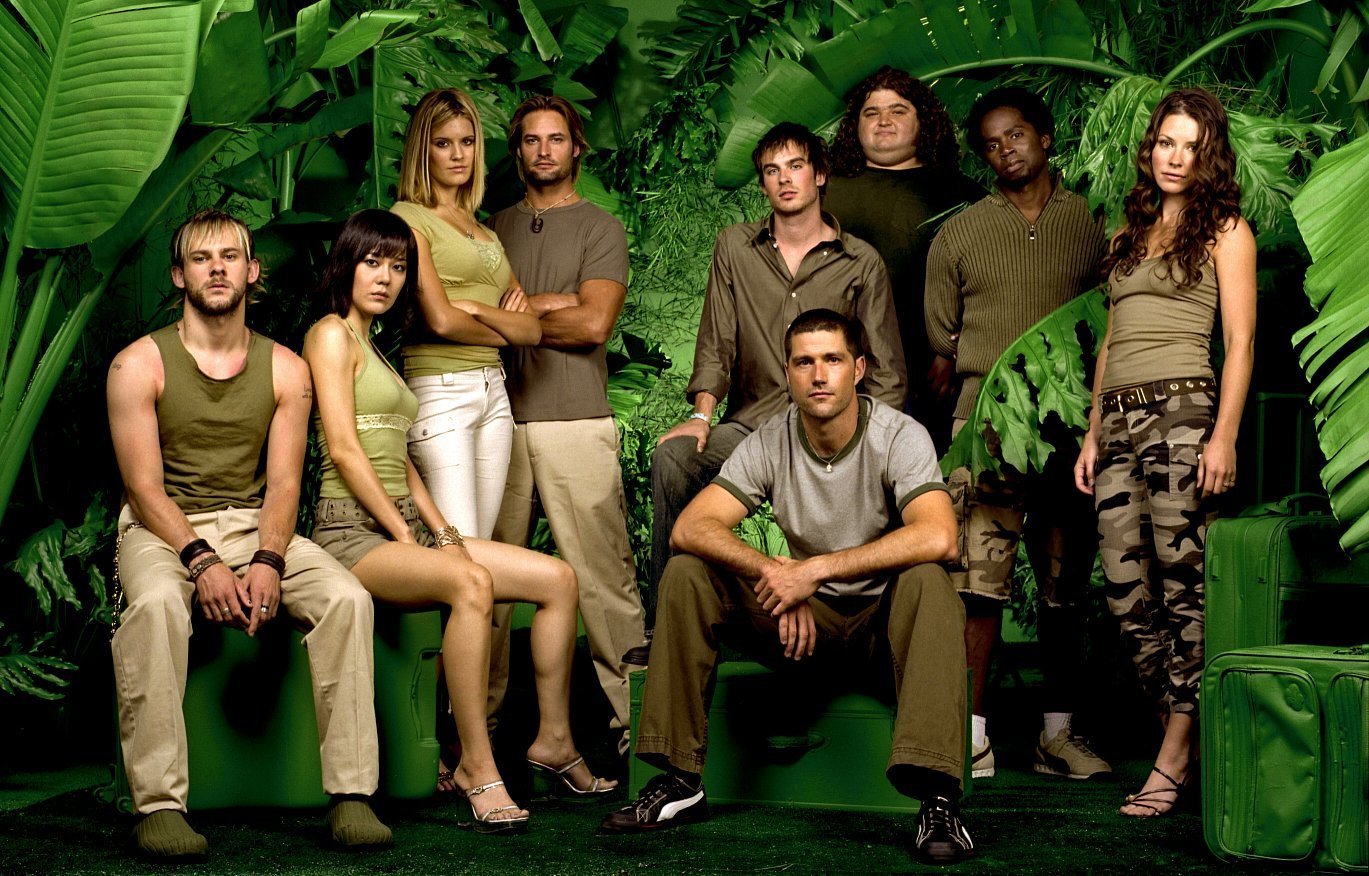
The main characters, just imagine them without these "stylish clothes" (but with ripped and filthy ones, you dirty-minded!) and... well, less make-up. Oh, someone's missing!
This poor guy they didn't want to have in the photo above is John Locke, one of the most interesting characters in fact. But all of them are epic guys. I won't give you any more information about them, because one of the main story mechanics of the series is gradually revealing you more and more little pieces of each character.
And that's one of the things that makes LOST so unique. Every episode shows you the current (of the story-intern present) happenings which are interrupted every now and then by narrations of the past of the characters, including the flight or their life before destiny called for them. Usually, the narrations are essential for the current events or give you important additional information to change your point of view.
Moreover, the amount of mysteries, secrets and WTF?-moments ("Was Tuen Frauen?", hence the abbreviation, is German and means something like "what the fuck happened" but being German obviously in a more aggressive way)* is really uncountable (so you should use "much", not "many").
When you just got the answer for one question, four more of them appear. But you can't stop watching.
Another variable (I've got a mathematic day today) for the success of the series is logically the setting. The dramatic situations are magic: they make disappear your fingernails! Really, sometimes you're suffering in front of the screen, but as we humans and especially we mystery lovers are a bit masochistic, we like that ;)
And that's all I can tell you. Actually I haven't told you anything, because to experience LOST is to find out the story step by step by yourself. And the island would never forgive if I'd anticipate you any event of the story...
Just one little tip: If you're going to give LOST a chance, please watch a least 4 or 5 episodes, because the pilot tends to give you a false vision of the series.
* Very strange humour, isn't it? Instead of laughing, try to find the message of my joke... or simply continue reading ignoring it.
As a matter of fact, we humans always desire to overcome the obstacles the nature left to us. We dream to fly, to have an eternal life or to control the feelings of other people. Many of us would like to gain one of these abilities, but are they really worth experiments on humans and moral?
On the one hand, it is true that the experiments on human life could help us solve a lot of problems. That is, we could discover the cure for some diseases or make possible some of our dreams. Therefore they could bring a lot of advantgages to most of us because we could enjoy the results of the experiments and make use of them.
But, on the other hand, what about the people involved in the experiments? They would have to suffer because of a small possibility to reach a certain objective after an indetermined time. Is it fair to let some people suffer so the others can enjoy? No one wants to die just for the sake of science or at least a very few people. In fact, there are people with severe economical problems who contribute voluntarily to experiments, but is it morally acceptable to possibly damage these people? Moreover, many of our dreams aren't as good as they seem. For instance, an eternal life for humans could have fatal consequences for ourselves, the other species and our whole biosphere.
To sum up, in my view there have to be strict limits set on the experiments on human beings. No experiments should be realised if they imply the possible harming of the subject, that is, reducing intentionally the mental or physical health of a person (no matter the probability). In addition, every experiment which attempts to break a rule of the nature's balance should be categorically forbidden.
I have been asked by my English teacher to tell you my opinion about our school and my suggestions to improve its system.
The first thing that I wanted to spot out is the need of more room and material. You know very well by yourself how the conditions are when we go to the laboratory in chemistry classes. Obviously it is a matter of money, too. But there are things that could already be done. For example the dining room which is one big place we could take more advantage of to redistribute the class assignments and the timetable. I would say the way the money is used should also be overthought. We students cannot know with precision how this matter is managed, but we can see some effects like the big TV screen at the entrance which is, in my opinion, completely useless.
Maybe the next point is an obligation by the government, but I would suggest to take out the physical education classes of 1st of Batxillerat. The subject has no more importance at this level (which is - at least in my opinion - proved by the fact that it is not present in 2nd of Batxillerat) because the students already do physical activities outside the school and the ones who have the intention to do a sports career are in another places now. Also a lot of us are not really happy with the subject because of the teaching of the PE teacher.
And this takes me to another suggestion. The idea to write you a letter to tell you our opinion is great. This should be applied on every teacher so they can try to improve, too. We students are trying to learn more and more and to get more responsible. So why should not some teachers that really do not satisfy the students with their methods try to change something, too?
I hope you take into consideration our opinion and you think about them.
I am looking forward to hearing from you.
Yours sincerely,
Christian Koch.
(hypothetical artistic and completely not readable sign)
 ...
...